The herds participating in the wildebeest migration spend December to March on the southern Serengeti plains, move northwest through the centre of the park in April and May, reach the Grumeti River in the west around June and July, arrive at the Mara River in the north between July and October, and turn back south in November.
That circuit is the whole of it. Once you understand it, planning a Migration Safari becomes far simpler, because the question stops being when I should go and becomes where I should be when I go. To simplify this, we have a month-by-month guide, which explains what each stretch actually offers a visitor.
Understanding the Migration
Most travellers arrive with one image in mind: wildebeest pouring off a mud bank into a river full of crocodiles. It’s real, and it is worth seeing.
But it represents perhaps three weeks out of a story that never actually pauses. Roughly 1.5 million wildebeest, travelling with several hundred thousand zebra and gazelle, move in a slow clockwise loop through the Serengeti–Mara ecosystem, chasing rain and the fresh grass that follows it. They do not gather for a season and then disperse. They are always somewhere, always moving, and the calendar below simply describes where they can be and when.
December to March – the southern plains, and half a Million Births
The year opens in the south. The herds settle on the short-grass plains around Ndutu and the southern Serengeti, and there is a reason they choose this ground.
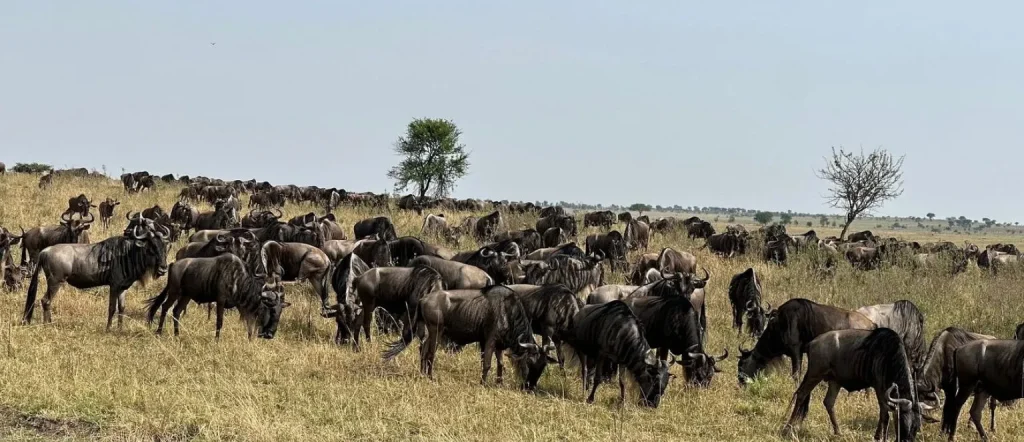
- Millions of years of ash from the Ngorongoro highlands settled here, building a shallow, mineral-rich soil.
- The grass it grows is short, which suits an animal that prefers to see a lion coming.
- It is unusually high in calcium and phosphorus, which is exactly what a wildebeest carrying a calf needs. The herds are not wandering in by accident. They are arriving at a nursery.
Then comes February, or thereabouts, and the plains do something few landscapes on earth can match. Between 400,000 and 500,000 calves are born within two to three weeks, with thousands arriving on a single morning at the peak.
The synchrony is deliberate in the evolutionary sense. Predators can only eat so much. By concentrating every birth into a fortnight, the herd guarantees that the great majority of calves survive simply by outnumbering the appetite arrayed against them. Individually, the odds are harsher, which is why a newborn wildebeest stands within minutes and can keep pace with a running herd within the day.
For anyone visiting, this is the most concentrated wildlife theatre of the entire cycle, and it is still overshadowed by the river crossings in most people’s imagination.
Three things make it exceptional:
- Predators are everywhere, and they are busy. Lions, cheetahs, spotted hyenas, and jackals all draw in. Cheetahs in particular thrive on these open plains, and the flat ground means you can often watch a hunt from the first crouch to the finish rather than losing it in scrub.
- You can see for kilometres. Nothing blocks the view. Behaviour unfolds in full rather than in glimpses.
- It is green, and it photographs beautifully, with the highlands standing up on the horizon behind the herds.
One caution worth holding onto. The exact calving ground shifts from year to year depending on where the short rains fell. Some seasons the herds sit tight around Ndutu, other years they drift east toward the Gol Kopjes. Anyone naming a precise valley months in advance is guessing, and guiding on the day matters more than any forecast.
April and May – the long rains, and the quiet park
By late March the grass is finished, and the herds start pulling northwest, spreading through the central Serengeti as they go. This is a slow, dispersed movement rather than a dramatic one, and it happens under the long rains, which is why these are the Serengeti’s emptiest weeks.
That emptiness is why you should consider going.
Rain here rarely behaves the way the phrase “rainy season” suggests. It usually arrives as a hard afternoon downpour that clears within an hour or two, leaving extraordinary light behind it. Mornings are often bright. Drives run as normal. You may get wet at some point in a week; you will not lose the week.
What you gain is considerable. Vehicles at a sighting drop away almost entirely. The plains are genuinely green rather than the bleached gold of August. And rates fall to their lowest point of the year, which in practice means the same budget buys either a better camp or several more nights, and more nights is almost always the better wildlife decision.
The marketing also obscures a point about migration. Resident wildlife does not migrate.
- The lion prides, leopards, cheetahs, elephants, buffalo, hippos, and giraffes of the central Serengeti are exactly where they were in August.
- The herds are a spectacle layered over an already extraordinary ecosystem.
- So a green season safari is not a compromised safari. It is a different one, with fewer wildebeest in frame and considerably more solitude.
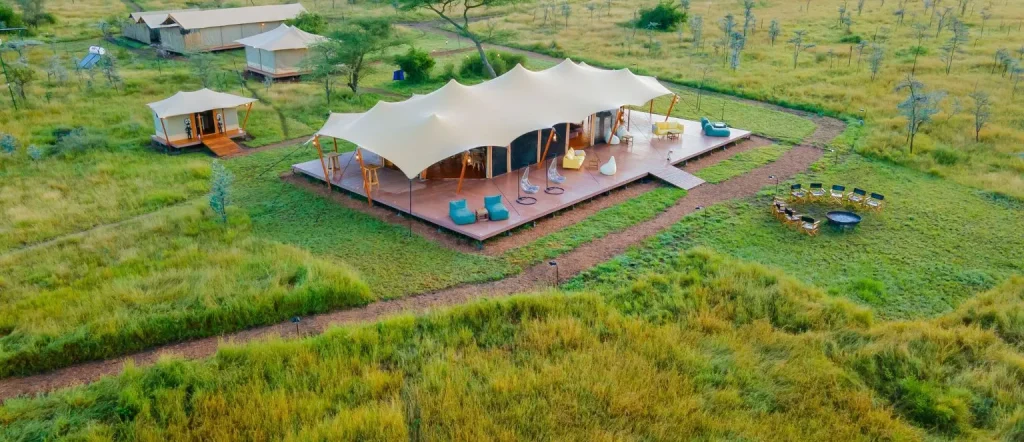
Because the wildlife stays put, where you sleep matters more than where the herds happen to be. Tamu Tamu Serengeti Camp sits around 45 minutes from Seronera, inside that resident wildlife country but outside the busiest cluster of camps. In practice, that means reaching the central circuit early while the first hour of the drive still belongs to you.
June and July – the rut, and the first river
Something changes in June. The scattered groups of April draw together into the long dark columns that appear in every aerial photograph of the Serengeti, sometimes stretching for kilometers across open grass.
- This is also the rut. Bulls carve out temporary patches of ground, bellow more or less without pause, and spar with anything that comes close.
- Almost all mating happens inside a compressed three-week window, and that compression is what produces the synchronized calving eight and a half months later.
- It is noisy, disorderly and, for most visitors, completely unexpected.
The first real obstacle appears as the herds push west: the Grumeti River, and the very large Nile crocodiles that live in it. Grumeti crossings are smaller, less predictable and far less photographed than what happens later in the north, which is precisely why they are worth knowing about. Very few vehicles go looking for them.
By the end of July, the leading animals are already well into the northern Serengeti.
July to October – the Mara River, and the season everyone books
This is crossing season, and Kogatende is where it happens.
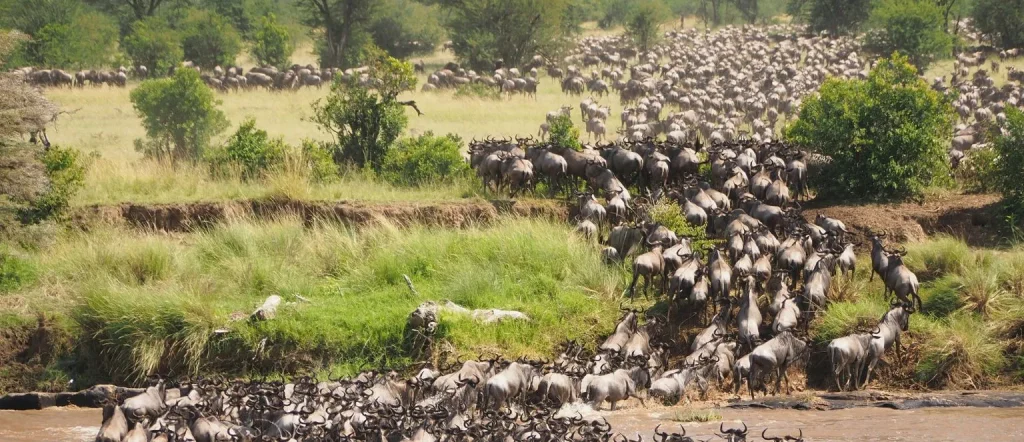
The Mara River cuts across the northern Serengeti, and the herds have no way around it. They cross repeatedly through these months, often doubling back within days, pushed by rain falling somewhere out of sight or by nothing an observer standing on the bank can identify.
It is worth being honest about what this looks like in practice, because expectations cause more disappointment here than anything else.
A crossing might involve two hundred animals or twenty thousand. It might last twenty minutes or most of an afternoon. Herds regularly build along the bank for hours, mass to what looks like the edge of committing, and then quietly turn and go back to grazing. There is no schedule and no guarantee, and any operator offering one on a specific date is selling confidence rather than knowledge.
What genuinely improves the odds is unglamorous:
- Be based in the north rather than visiting it. Day trips from the central Serengeti arrive mid-morning and leave mid-afternoon, which brackets out most of what happens.
- Give it three nights, ideally four. Two nights is a coin toss. Each additional night significantly compounds your chances.
- Leave early and stay out. Take lunch with you. The people who see crossings are usually the people who were already parked when it started.
- Go with guides who know the river. Reading how animals bunch and drift along a bank, knowing which regular crossing points are in play, and holding position without pressuring the herd is a skill built over seasons.
That reasoning is why Tamu Tamu Kogatende sits where it does. Being close to the river means being in place while the herds are gathering, rather than arriving after the moment has passed.
The north also deserves attention on its own account, quite apart from the wildebeest. It is hillier and more varied than the central plains, with granite kopjes, riverine forest, resident elephant and excellent big cat country, and outside these four months it is one of the least trafficked parts of the park.
November – The turn for home
The short rains arrive, the north empties out, and the herds swing back down through the eastern Serengeti toward the plains where the year began. By December they are grazing on the same short grass, pregnant again, and the whole circuit resets.
November is easy to overlook and often shouldn’t be. The park is green, the herds are actively on the move rather than settled, visitor numbers have dropped away, and rates sit well below peak. For travellers who want movement and space at the same time, it is one of the better months on the calendar.
Planning around the Loop
The single most common mistake is booking the right month in the wrong region. A July trip based in the south, or a February trip based in the north, will miss the herds entirely, and no amount of good guiding fixes a 400-kilometer gap.
| Months | Where the herds are | What’s happening | Sensible base |
| Dec to Mar | Southern Serengeti, Ndutu plains | Calving season, peak predator activity | Southern Serengeti / Ndutu |
| Apr to May | Central Serengeti, moving northwest | Long rains, green season, herds dispersed | Tamu Tamu Serengeti Camp |
| Jun to Jul | Western Corridor, Grumeti River | The rut, Grumeti crossings, columns forming | Central or Western Serengeti |
| Jul to Oct | Northern Serengeti, Kogatende | Mara River crossings | Tamu Tamu Kogatende |
| Nov | Eastern Serengeti, turning south | Short rains, herds heading back down | Central Serengeti |
Read that as a pattern rather than a timetable. The herds follow rainfall, and rainfall arrives when it arrives.
Two further things tend to make the difference between a good trip and a frustrating one.
Combine regions rather than chasing one. Six or seven nights split between the central Serengeti and the north gives you resident predators and migration drama both, with a short bush flight rather than a full day’s driving in between.
Stay longer in fewer places. Two nights somewhere is a gamble; three or four is a plan. Transfers eat into game-viewing hours, and ambitious itineraries usually deliver less than modest ones.
Getting there
| Route | Typical time |
| Arusha to central Serengeti by road | 6 to 8 hours |
| Arusha to Seronera airstrip by air | 1 to 2 hours |
| Arusha to Kogatende airstrip by air | Around 2 hours, often with one stop |
| Seronera airstrip to Tamu Tamu Serengeti Camp | About 45 minutes |
What to bring
Layers, because dry season mornings are genuinely cold and midday is not. Neutral colours. Binoculars, which remain the most underrated item anyone packs. More lens than you think you need, plus somewhere dustproof to keep it. A light rain shell if you are travelling in April, May or November.
Where the trip Begins and Ends
Almost every Serengeti Safari starts and finishes in Arusha, and a long-haul arrival day is a poor moment to head straight into the bush. Olerai Lodge sits ten minutes from Arusha Airport and about an hour from Kilimanjaro International Airport, which is why many guests spend their first night there shaking off the flight and their last one there before flying home. Gardens, coffee plants, Mount Meru on the horizon, and monkeys moving through the grounds without being invited.